4 Quick Checks for Patients and Caregivers on AI Medical Summaries
Four quick checks patients and caregivers can run on AI medical summaries. What to verify, privacy questions, and why 81.6% prototype accuracy matters.

4 Quick Checks for Patients and Caregivers on AI Medical Summaries
AI medical-record summaries turn your clinical notes, lab reports, and prescriptions into a short, plain-language overview. They’re built for real moments: an ER visit, a new doctor, a caregiver trying to catch up fast. Use them for that. Never treat them as the final word on a dosage, a date, or a critical lab value. Always check those against the original document, and pick a HIPAA-ready service like MedFiles.ai to handle the data safely.
TL;DR:
- AI summaries currently achieve about 81.6% accuracy on clinical checklist criteria, but near one in five details may be incorrect or misaligned.
- Structured data extraction before summarization improves reliability, while unstructured sources often lead to errors like confabulation and temporal confusion.
- Privacy and security protections are essential; verify if platforms use encryption, support data deletion, and restrict AI training from your records.
- Use summaries as quick reference tools during emergencies or visits by building concise, up-to-date pages with allergies, medications, labs, and provider info.
- Expect future developments to include source-linked outputs, deeper FHIR integration, and increased transparency around accuracy and data use policies.
Table of Contents
- What Does an AI Medical Record Summary Actually Include?
- How Does AI Actually Generate a Health Record Summary?
- How Accurate Are AI Medical Summaries, Really?
- What Privacy and Security Should You Confirm First?
- How Do You Use an AI Summary in an Emergency or Doctor Visit?
- What Should You Look For in a Patient-Facing AI Summary Platform?
- Why Doesn’t AI Just Plug Into Your Hospital’s Records?
- What Rules Govern AI Health Summaries Beyond HIPAA?
- What Are the Real Limitations of AI Summarization Right Now?
- Where Is This Technology Headed Next?
- Why We Built Patient-Facing AI Summaries This Way
- Start Organizing Your Medical Records With MedFiles.ai
- Sources
What Does an AI Medical Record Summary Actually Include?
A good summary pulls the pieces that matter and leaves the noise behind. You’re not getting a copy of your chart. You’re getting the parts you’d actually need in a hurry.
Most patient-facing summaries include:
- Current diagnoses and active health conditions
- Medications with dosages and prescribing dates
- Known allergies and adverse reactions
- Lab results flagged as abnormal or out of range
- Recent procedures, surgeries, or hospitalizations
- Follow-up instructions and provider contact information
This matters because confusion is the default state for most people holding a stack of medical paperwork. A summary shortens the gap between “I have all this information” and “I understand what it means.” It also speeds up caregiver handoffs. A daughter managing her father’s diabetes care doesn’t need every page from three specialists. She needs the current insulin dose and the last A1C number.
One clarification worth making early: this kind of summary is built for you, the patient or caregiver, not for a courtroom or a hospital’s legal department. Attorneys and health systems use a different category of tool for legally defensible chronologies. What you’re reading about here is the personal health record version, designed for understanding and sharing, not litigation.
How Does AI Actually Generate a Health Record Summary?
The process starts with your data, wherever it happens to live. That could be a PDF discharge summary, a photo of a prescription label, an export from your patient portal, or a structured data file called a FHIR bundle (Fast Healthcare Interoperability Resources, the standard format hospitals increasingly used to exchange records).
Before any summarizing happens, the system has to clean and organize that raw material:
- Optical character recognition (OCR) converts scanned images and photos into readable text.
- Structured extraction pulls out specific fields, like a medication name, its dose, and the date it was prescribed, rather than treating the whole document as one blob of text.
- Privacy-aware preprocessing detects and masks personally identifiable information before the summarization step runs, a method described in recent privacy-focused AI research on medical summarization.
Only after that does a large language model (LLM) generate the actual summary, often guided by a checklist or template rather than left to write freely. Research on personal health record context shows that grounding the model in structured patient data, instead of a generic prompt, meaningfully improves how helpful its answers are. Structured extraction first, summarization second. That order is why some tools are more reliable than others.
Pro Tip: Ask any platform you’re considering whether it extracts labs and medications into a structured format before generating your summary. Tools that skip straight to “read the document and summarize it” tend to produce softer, less precise output.
How Accurate Are AI Medical Summaries, Really?
The honest answer: good, not perfect. A 2025 prototype that summarized FHIR-formatted personal health data using large language models hit roughly 81.6% accuracy on checklist-based clinical criteria. That’s a genuinely promising number for an emerging technology. It also means close to one in five checklist items didn’t line up correctly.
81.6% — the accuracy rate researchers measured for a FHIR-based AI summarization prototype against structured clinical checklists in 2025 testing.
The failure modes worth knowing about are specific, not random. Studies evaluating LLMs with personal health record context flagged temporal disorientation and confabulation as recurring problems, meaning the model sometimes mixes up when something happened or states a detail that sounds plausible but isn’t actually in your records.
Before you act on any AI summary, run through this checklist:
- Confirm every medication name and dosage against the original prescription or discharge paperwork.
- Cross-check critical lab values, especially anything flagged as abnormal.
- Verify dates of procedures, diagnoses, and follow-up appointments.
- Confirm emergency contact and provider information is current.
Five minutes of checking beats an hour of confusion later.
What Privacy and Security Should You Confirm First?
Before you upload a single document, get straight answers on how the platform handles your data. This isn’t optional homework. It’s the difference between a tool that protects you and one that quietly becomes a liability.
Start with the basics:
- Is the platform HIPAA-ready, and can it explain in plain terms what that covers?
- Is data encrypted both in transit and at rest?
- Does it offer two-factor sign-in and permission controls for family profiles, so you decide who sees what?
- Does it keep audit logs and have a clear breach-notification policy?
Then dig into the policy details that most people skip:
- Does the platform use your records to train its AI models, or keep them siloed to your account?
- What’s the retention policy, and can you fully delete or export your data on demand?
- Who gets access when you share a summary, and for how long?
Governance researchers reviewing consumer-facing health AI tools recommend exactly this kind of scrutiny, pointing to disclosure and post-deployment monitoring as baseline expectations, not extras. MedFiles.ai builds its security architecture around end-to-end encryption and HIPAA-ready infrastructure for this reason.
Pro Tip: If a platform can’t clearly answer “do you use my data to train your AI,” that’s your answer. Move on.
How Do You Use an AI Summary in an Emergency or Doctor Visit?
A summary only helps if it’s built for the moment you need it. An ER intake form and a specialist consult call for different formats, but the prep work follows a similar path.
- Build a one-page emergency summary listing allergies, current medications with doses, major diagnoses, and the most recent critical lab results.
- Export it as a secure share link or a passworded PDF, depending on who needs it and how fast.
- Decide what to print and what to pull up on your phone. Paper works when Wi-Fi doesn’t; a phone screen works when you need to zoom in on small print.
- When sharing with a clinician, send it through a system with an audit trail, like a secure message through your provider’s portal, rather than an unsecured email attachment.
Clinicians will still pull up your full chart and originals. A well-organized summary just gets everyone oriented faster, which matters most in the first five minutes of an emergency room visit.
What Should You Look For in a Patient-Facing AI Summary Platform?
Not every tool built for this job is built the same way. Before you commit to one, run through a short checklist that separates the reliable options from the flashy ones.
Look for:
- Clear HIPAA-ready infrastructure and a straightforward privacy policy, not legal boilerplate
- Export and portability, so your data isn’t locked in if you switch services
- Support for multiple family profiles, since caregivers often manage records for more than one person
- A correction or annotation workflow that lets you flag an error in a summary
- Audit logs and sharing controls that show exactly who accessed what, and when
When you’re talking to a vendor or reading their support documentation, ask directly: where does patient data come from, how long is it retained, is it used for model training, and what features exist for clinicians who receive a shared summary.
Most legitimate platforms offer a free trial. Use it to test the tool on your own records before trusting it with anything urgent, comparing the summary line by line against your original documents to see how close it actually gets.
Why Doesn’t AI Just Plug Into Your Hospital’s Records?
If AI summarization is this useful, a reasonable question follows: why can’t it just pull everything automatically from your hospital’s system? The answer comes down to how fragmented American health records still are.
Most hospitals and clinics run on Electronic Health Record (EHR) systems from a handful of major vendors, and each one structures data differently. One provider’s export might use the FHIR standard cleanly. Another might bury lab values in a scanned PDF with no structured data at all. A prototype summarization tool tested with FHIR bundles performed well specifically because FHIR gives structured, standardized access to patient data. Without that structure, an AI system has to work much harder just to identify what’s a medication versus what’s a billing code.
Patient portals compound the problem. Each hospital system, specialist network, and pharmacy tends to run its own separate portal, and few of them talk to each other automatically. That’s part of why patient-facing platforms ask you to upload documents manually or connect through standardized data-sharing protocols instead of promising a single automatic pipeline from every provider you’ve ever seen. A patient portal is a good starting point for gathering your own records, but consolidating across providers still usually requires some manual work on your end. Interoperability is improving. It isn’t solved yet, and any platform that claims instant, automatic access to every record you’ve ever generated is overselling what current infrastructure supports.
What Rules Govern AI Health Summaries Beyond HIPAA?
HIPAA covers privacy and security of your health information, but it doesn’t regulate whether an AI tool’s summary is accurate or how the tool should behave when it gets something wrong. That gap is where newer conversations about AI accountability come in.
The Food and Drug Administration has authority over software that functions as a medical device, but a patient-facing summary tool that organizes and simplifies your own records typically sits outside that category, since it’s not making a diagnosis or treatment recommendation. That distinction matters for how these tools are marketed. A platform that starts suggesting treatment changes based on your summary is moving into different regulatory territory than one that simply organizes what your doctor already told you.
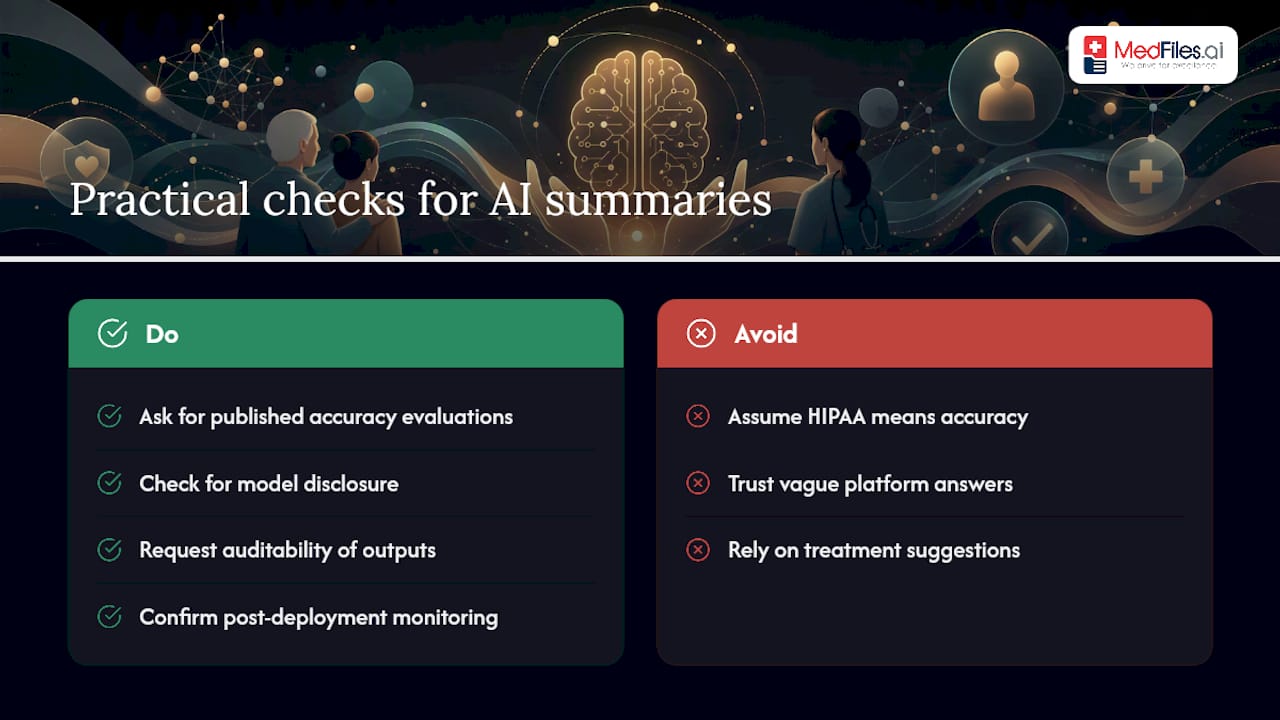
Governance researchers looking specifically at consumer health LLMs have proposed a more detailed framework, identifying six domains that need oversight: privacy, accuracy, equity, transparency, and two others tied to accountability when the AI gets something wrong. Their core recommendation is straightforward: platforms should disclose how their models work, allow auditing of outputs, and monitor performance after the tool is actually in use, not just during initial testing.
For you as a patient, the practical takeaway is this: don’t assume a HIPAA badge means the AI itself has been vetted for accuracy. HIPAA protects the data. It says nothing about whether the summary generated from that data is correct. Ask platforms directly whether they’ve published any accuracy evaluations, and treat vague answers as a red flag.
What Are the Real Limitations of AI Summarization Right Now?
Every AI summarization tool inherits limitations from the technology underneath it, and understanding them helps you use these tools without being blindsided.
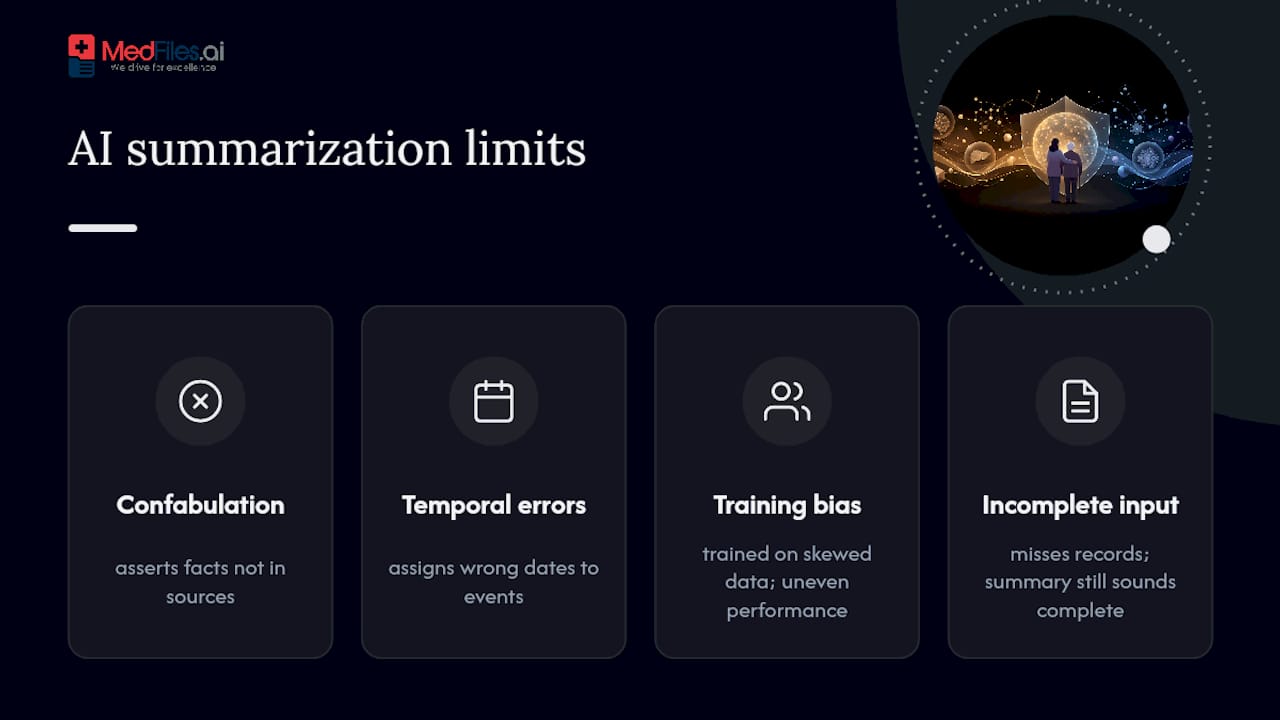
The most common failure is confabulation, where a model states something confidently that isn’t actually supported by your documents. This happens more often with unstructured or poorly formatted source material, which is one reason structured extraction before summarization tends to produce more reliable results. Temporal confusion is nearly as common. A model might correctly identify that you had a procedure and correctly identify a date somewhere in your file, then pair the wrong date with the wrong event.
Bias is a subtler issue. Most large language models are trained on datasets that skew toward certain populations, medical terminology conventions, and documentation styles common in specific health systems. If your records come from a smaller clinic, a non-English-language provider, or use less common formatting, a summarization tool may perform less reliably simply because it has seen less similar data during training. This isn’t a flaw unique to any one platform. It’s a structural limitation of how these models learn.
There’s also a completeness problem. A summary is only as good as what it’s given. If you upload three of your five specialists’ records, the summary will confidently describe an incomplete picture without necessarily flagging what’s missing. That’s why platforms with an explicit “verify with original” feature, one that shows the exact source text behind each summary sentence, make it meaningfully easier to catch these gaps before they become a real problem.
Where Is This Technology Headed Next?
The trajectory is toward tighter integration between structured data standards and more transparent AI outputs, not toward less human oversight.
Expect wider adoption of source-linked summaries, where each sentence in your AI summary connects back to the exact paragraph or lab value it came from. This single feature does more to build trust than any accuracy percentage, because it turns verification from a full document search into a two-second click. Expect deeper FHIR integration as more health systems adopt the standard, which should gradually reduce the manual upload burden that still defines most patient experiences today.
Governance frameworks will likely formalize further, following the disclosure and monitoring recommendations already proposed by researchers studying consumer health AI accountability. Expect more platforms to publish their own accuracy testing rather than leaving patients to guess, and expect regulatory attention to sharpen around the line between “organizing your records” and “making clinical recommendations.”
None of this replaces the fundamentals. Verify critical numbers. Understand what a tool actually did with your data. Choose a platform that treats your privacy as a foundation, not an afterthought.
Why We Built Patient-Facing AI Summaries This Way
We started MedFiles.ai around a simple frustration: people’s medical history lives scattered across portals, drawers, and phone photos, and nobody organizes it for them. Our platform lets individuals and families securely store, organize, and access their records with HIPAA-ready infrastructure and end-to-end encryption from day one.
We built automatic organization because manual filing is where most people give up. We added family profiles because caregivers manage more than their own health. Every summary feature we ship gets weighed against one question: does this make it easier for a patient to verify their own information, or does it just make the output look impressive? We keep choosing the first answer.
— Team
Start Organizing Your Medical Records With MedFiles.ai
Some platforms give you a single, secure home for your medical records, instead of a folder of scanned PDFs and multiple portal logins. 
The platform handles automatic organization of everything you upload, runs AI-powered analysis to surface what matters, and supports family profiles so you can track records for a parent, a child, or yourself without juggling separate accounts. Every document sits behind HIPAA-ready security and encryption, and sharing happens through controlled links rather than unsecured email attachments.
Getting started is simple. Create a free account, import or connect your existing records, and build your first emergency summary in one sitting. Invite a caregiver or family member if you want shared access, and use secure sharing when it’s time to send a summary to a new provider. Just remember the rule from earlier: verify critical facts against your original documents, and let your clinician make the actual medical decisions. Set up your medical document storage today and see how much lighter this gets.
This article is general information, not a substitute for advice from a qualified doctor. Consult a qualified healthcare professional about your own circumstances before acting on anything here.
Sources
- Design and Development of a Summarization Service Prototype of Personal Health Record Medical Data with Fast Healthcare Interoperability Resources Structure Using Large Language Models
- Evaluation of PH-LLMs with PHR context (preprint/study)
- Privacy-Aware AI, Health Report Interpretation, Large Language Models, Medical Summarization, Explainable AI